
Boys and Girls Boys, then Girls
“The Taliban are doing so much good these days.”
Come again?
“Well, apart from their treatment of women. But other than that, they’ve been doing so well.”
I’m in a taxi home after a particularly quiet afternoon in London. My driver grew up in Kabul. “Pashto Mix” plays in the background while we talk about life in Afghanistan before, and after 2021.
I am transported back to 2023, when I had a chance to take a peek inside this reclusive country.

In this part of the world, it’s not unusual to see working children. A boy, not yet a teenager, carefully weighs some carrots on an iron scale. He wears a perfectly symmetrical grin, and negotiates a price with a larger man. The man towers over him, but he’s not fazed! Outside of the frame, the same man beams back at this entrepreneur.
The girls don’t smile as often.
In this part of the world, women are restricted from many activities deemed unfit for them. Since the fall of Kabul in 2021, the American- and NATO-backed Islamic Republic of Afghanistan has seen themselves supplanted by His Excellency Mullah Hībatullah Akhūndzāda, their Supreme Leader, their Commander of the Faithful, and of course, his Taliban forces. Afghanistan is now, officially, a newly restored Islamic Emirate. This was 2023, and already I was struggling to picture what life was like just two years before that; before the 15th of August, 2021.
Facing no real opposition, the regime has been able to govern the country fairly in line with their hardline ideologies. Arguably, some policies have had positive outcomes, by way of: 1. the supposed repression of the Islamic State terror organisation, 2. severe crackdown on opium production, and 3. enforcement of death penalties for Bacha Bazi (this is a millennium-old practice of adolescent sex slavery that the U.S.-backed Afghan republic had turned a blind eye towards).
Unsurprisingly, the women suffer. Since their resumption of power, this new administration has imposed laws precluding their participation in secondary education, politics, and many employment opportunities. I meet a labourer tasked with women’s bag checks during a customs crossing, an intelligent lady fluent in English, along with several other languages. In what felt like a previous life, she was the head accountant in her province’s Ministry of Culture.

More recently, women have also been barred from Band-e-Amir national park, a significant nature reserve celebrated for its spectacular lakes and cliff edges. The reason: too many visiting have not been complying with proper hijab etiquette. Apparently, headscarves had not been worn in a respectable manner. Once a popular picnic spot for family barbecues and larger gatherings, we find ourselves quite alone in this vast, magnificent space. Here, leniency towards foreign women is erratic. I was allowed in with some persuasion and a surprisingly laid-back officer.
In 2022, approximately a hundred women were prevented from boarding a plane intending to escort them to fully-sponsored studentships to the University of Dubai.
Public parks and bathhouses in the capital city, Kabul, are also limited to men, as well as children accompanied only by their fathers.
I understand why the girls don’t smile as often.
Sometimes, I am afforded a hello and timid giggle. Foreign women have the honour of the occasional curious exchange with local Afghani girls – we rarely see people like you anymore!
Foreign men don’t have this privilege. All for the better, as it keeps them out of trouble from the hardline militants.

I helped my friend take a picture of Sakhi Shrine in Kabul. We entered this fabled site with the agreement that we will not engage in conversation with the locals, and that the men will not take pictures with women in frame. It’s quite impossible to photograph this crowded space without capturing a woman in frame, but the Mullah is strict in enforcing his belief that men should never commit such an indecency.
The women must be protected.
A gaggle of girls approach us just by the square of the shrine. Where are you from? Can we take a picture together? I’m sorry, we’re not allowed to speak with you. I don’t know why.
In another city, we meet an English teacher called Hila. She explains her name, which comes from a Pashtun word loosely translated as hope. Two years ago, Hila was a hair’s breadth away from finishing sixth form school, before the new ruling government decided to restrict girls from studying beyond the elementary grades. She explains, however, that she has several elder sisters in “university”; private academies administering an assortment of courses that are, strangely, permitted to receive women. Some of these academies teach tertiary-level medical, engineering, and language “degrees”. No longer eligible to complete secondary school, Hila went on to learn English independently, rapidly reaching working proficiency and later finding herself teaching in an academy, all within 18 months.
Those with the pluck to defy an unforgiving government look towards clandestine schools for hope. Often run during ungodly hours, this practice is largely hidden from the authorities, and sometimes from their own families. These days, public girls’ secondary school buildings are often abandoned or repurposed for something supposedly more ‘valuable’. Oftentimes – other locations, sometimes abandoned – also get repurposed, for the entirely opposite cause. This is done covertly, for the ideals of preserving the dreams and the futures of these gutsy girls.
For the resourceful, reliable internet connection occasionally allows them the opportunity to complete high school or higher education remotely. Families with enough finances, and authority, are permitted to send their girls overseas. It is no secret that many from the Taliban leadership do in fact expatriate their girls to Pakistan and the United Arab Emirates, for just that reason.
Those who cannot access private schooling or the internet are doomed to stay home and emulate the lives of women in the holy books. Funnily enough, there is a growing industry of women leading and owning small businesses, mentoring each other to survive an onerous existence. We pass two little girls clearing leaves from the path outside a shrine. They hesitate to interact, but I take a picture anyway.
Just this week, I meet a Saudi couple at dinner, highly educated oil consultants living in London. Really? They’ve told you all this – it’s not just western propaganda?
Afghan women are tough, and they wouldn’t like us to think that they’ve given up. Forty years of war isn’t enough to shake their resolve; and much like Hila, these girls hang on to the hope that one day, things will be better, and they will come out as survivors.

It’s Nothing Unusual
We meet another Afghan man: a young lad, full of life, and also full of unimaginable trauma. My experiences are normal, he says, many of my friends have done the same. He helps us negotiate our entry into the local Bushkazi game; a sport on horseback, a warrior’s legacy left by Central Asian nomads from the 11th century.
Of course, I was officially not permitted to attend, on the basis of being a woman. We managed to negotiate with the staff that I was a foreigner, and thus somehow more deserving of leniency than the Afghanis.
We hear his story during the game.

His name is Asad, the lion. Youngest of eight children, he is a twenty-five year old man with a fierce courage deserving of his name. My eldest brother is the third child of our family, he explains, and our parents had sold all of their belongings to try and provide a better future in the United Kingdom, legally. The visa itself had cost them everything they owned.
Asad does not divulge the name of his brother, but reveals that the last time they interacted, he had given up all hope for a better future. Trapped in a refugee camp somewhere in Germany, the brother is homesick, and has been struggling to assimilate into Western life. In his second year, he had cut off most contact with his family in Kabul, and ceased sending support money home. At this point, the family had effectively no worldly possessions to their name, as well as a prodigal son.
Seeing no better alternative, an eighteen-year old Asad heads south, through the region of Balochistan, Iran proper, and then Türkiye. It took him six months to learn Turkish, an achievement that was not particularly marvellous, according to this determined young lad. Most of the trip was done by foot. With my friends, we walked, we ran, we climbed, and we crawled. Through international border crossings, they would hide inside the boot of a car, in complete silence. Sometimes, they wouldn’t eat for a fortnight at a time.
Once, Asad fell very ill. Leave me alone, he told his friends. Leave me here to die, and save yourselves.
They eventually made it to Istanbul, with no one left behind. It was hard, but to be honest, it wasn’t really anything out of the ordinary, he recalls. I thought I was going to die, but my friends wouldn’t let me.
Five glorious years pass, and Asad manages to do what his brother couldn’t, recovering some of the losses incurred by his family all those years ago. He finds happiness for the first time, despite the tremendous fear of discovery and deportation. My favourite spot there was inside the Hagia Sophia. I got to meet so many people from all these different countries there.
One day, Asad’s employer at the market asked him to purchase some supplies an hour earlier than usual. A policeman found this suspicious and asked for his papers. Unsurprisingly, he soon found himself inside the bed of a truck on his way back to Kabul. He returned to find his previously war-torn home, now transformed into a totalitarian, theocratic regime. Why didn’t I run from that guy?
Asad sees his journey as a failure, but is hopeful that one day he might be able to try again.

A tenacious young competitor manages to grab hold of the leather-bound, headless sheep carcass and carries out a victory lap across the field. Proudly, he scores a well-earned bounty and drops the decapitated corpse into its designated goal. It’s a vicious sport with no teams – each man for himself, with a promise of great reward should he succeed.
We hear the bellow of a proud winner, and decide to call it a day.

Mood Swings
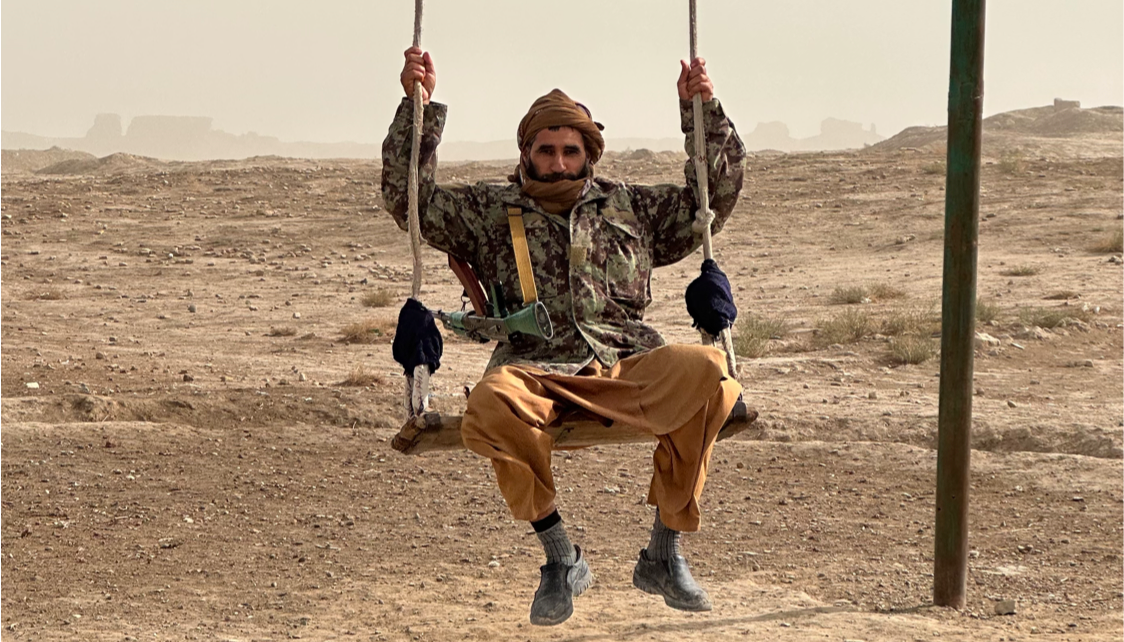
A Talib waits for us at a checkpoint within the archaeological region of Balkh. The country’s north-east, along with famous provinces Panjshir and Samangan, are historically known to host various anti-Taliban belligerents. They were one of the last strongholds to fall during the takeover in 2021. Our unnamed soldier wears a stern face draped over a long scraggly beard, military jacket, and a loaded, green Kalashnikov rifle from his old mujahideen days. A livery of honour for the devoted soldier.
He enters our car and promptly sits in the front seat, loaded rifle resting across his chest. We commuted silently as our driver takes us to various archaeological and natural treasures across the Balkh and Samangan provinces. It was a very windy day.
I hear a yelp as my friend loses his traditional Pashtun cap, the Pakul, to a gust of wind. We hear an unexpected cackle – never have we imagined this sound to come out of our severe Talib escort. He cracks a smile, and follows me for the next half hour. Soon enough, we find ourselves playing on the swings with our new friend. He’s looking for a fourth wife in you, they say, a running joke amongst our group for the rest of the day.

We part ways with the friendly soldier and reach Mazar-e-Sharif, a bustling city with a fabled Blue Mosque, alternatively known as the Shrine of Hazrat Ali. A tabby sneaks through one of the complex’s ornately tiled blue gates. Of course, women are not permitted in without special permission from the authorities, but I did catch a glimpse of the grandiose complex beyond the gates. This was a strictly non-negotiable rule. How lovely that cats have more rights than me, in this part of the world.
I wonder how many women have tried fleeing, as Asad had done.
Last Modified 8 January, 2026